Most Chicago neighborhoods have one center of gravity. Rogers Park has two, and they usually keep to themselves. The lakefront strip east of Sheridan runs on tide schedules, lifeguard whistles, and the 96 Lunt bus. The Glenwood Arts District two blocks inland runs on curtain times, gallery openings, and the Red Line rumbling overhead. For most of the year a resident picks a lane.
August is the exception. For three weeks the two corridors share a calendar, and if you live here it is worth planning around.
Why the corridors usually don't overlap
The lakefront and the arts district sit within a ten-minute walk of each other, but they were built for different lives. Loyola Park was the sole park created by the North Shore Park District, which by 1917 had acquired more than nine acres of lakeshore property for a single beachfront park. The Glenwood district grew up along the embankment of the elevated train, a working commercial spine that later filled in with studios and stages.
The result is two street grids with different logic. The beach corridor is oriented east-west toward the water, dead-ending at sand. Glenwood runs north-south under the tracks, a linear strip. You do not accidentally walk from one to the other. You commit.
The August festivals are the one time the neighborhood shrugs off that geography and treats itself as a single place.
The August calendar, dated
Three named weekends do most of the work. Put them on the fridge now.
| Date | Event | Where |
|---|---|---|
| Fri, Aug 8 | Jarvis Square Pierogi Fiesta | Jarvis Square, near the Jarvis Red Line |
| Aug 14–16 | Glenwood Avenue Arts Fest (GAAF) | Glenwood at Morse |
| Sat, Aug 22 | Chalk Howard Street | Howard Street corridor |
WTTW's 2026 festival guide lists all three under Rogers Park in August.
GAAF is the anchor. This year is the 25th Annual Glenwood Avenue Arts Fest, a weekend event organized by the community that has run for over two decades on a volunteer-driven model. The 2026 dates are August 14–16 in the heart of Rogers Park, featuring over 140 artists working across painting, ceramics, jewelry, photography, textiles, mixed media, and sculpture. The event takes place on the cobblestone streets of the Glenwood Avenue Arts District at Morse and Glenwood, steps from the Morse CTA Red Line stop, and features food from local eateries alongside art, music, dance, and live demonstrations.
Two things to know if you have lived here long enough to have opinions. First, the footprint is small and the crowd is not. Aggregator sites have estimated attendance in the tens of thousands, so if you want to actually talk to the artists, come Friday evening or Sunday before noon. Second, the district itself is worth walking any weekend of the year. Rogers Park's arts and entertainment district stretches along Glenwood at Morse in an urban corridor of mixed-use buildings with narrow cobblestone streets, murals on the elevated train embankments, and quaint storefronts.
What the beach corridor gives you the rest of the summer
If GAAF is the social peak, the beaches are the daily texture. Rogers Park has more of them than any other Chicago neighborhood, and they are not interchangeable.
- Loyola Beach. The busy one. Loyola Beach hosts many recreation programs as well as a nearly 2/3-mile walking trail along Lake Michigan. At nearly 41 acres, Loyola Park includes the beach plus baseball and softball fields, basketball and tennis courts, a playground, a large fieldhouse, beach volleyball, a natural dunes area, sculptures, and public art. Come here for the mural wall and the field house programming.
- Loyola Beach Dunes. A different reason to visit. Nearly seven acres of native dune habitat where visitors can spot nesting shorebirds and native dune wildflowers from paved trails and the Loyola Beach pier, with soft-surface sand paths giving close views of the biodiversity. Best at sunrise.
- Leone Beach. The lap swimmers' pick. Leone Beach has a playground and kayak launch, with distance swimming available from Lunt to Farwell parallel to shore.
- Tobey Prinz Beach. Small but mighty, part of Tobey Prinz Beach Park with an abstract seating installation and a quaint grassy knoll, relatively quiet and uncrowded.
- Helen Doria Beach. Just short of an acre, connecting North Shore Beach with Loyola Beach via the lakefront; breezy and chill, named in 2016 after longtime Rogers Park resident and arts and parks supporter Helen Doria.
The practical read on this is that residents rarely pick a beach by name. They pick by what they want to avoid. Weekend crowds and a bag chair? Loyola. A morning swim before work? Leone, in the Lunt-to-Farwell lane. A quiet coffee walk? Tobey Prinz. Birding? The dunes.
Midday in the summer isn't the best time for open water swimming at Loyola Beach, due to crowds and lifeguards. But it's a great time for a paleta and playing in the sand.
That is from an open water swimming log, and it maps to how the neighborhood actually uses the shore. The lifeguards' presence is a feature for families and a constraint for early swimmers, and the calculus flips before 11 a.m. and after 7.
The murals are a route, not a backdrop
If you walk Glenwood between festivals, walk it with a purpose. The Mile of Murals, a community-based public art initiative, runs along Glenwood Avenue, totaling over 14,000 square feet of painted walls across 14 bold, large-scale works reflecting the history, culture, and spirit of Rogers Park, spanning five block-long pieces, seven viaducts, and one overpass.
That is a specific number worth holding onto. Fourteen viaducts and overpasses is roughly the length of the residential Glenwood strip from Morse to Pratt. You can do the full route in about forty minutes on foot with stops.
What's new, and what's coming
Two openings and one plan matter to anyone tracking the neighborhood's next chapter.
Monarch Community Cafe opened at 7010 N. Clark. Rogers Park Metra riders now have a place for a quick pre-commute caffeine boost right by the station, with coffee drinks, pastries, and dishes like a ham and gruyere sandwich or kale harvest salad. WTTW describes it as wanting to be a neighborhood gathering place in Rogers Park. The location is the tell. A cafe that stakes its identity on the Metra stop rather than the Red Line is betting on the westernmost slice of Rogers Park that most neighborhood coverage ignores.
The Engine Co. #102 firehouse at Greenleaf is the more interesting long play. A new hospitality concept is planned for the former Engine Co. #102 fire station at 1721–23 W. Greenleaf Ave., a city-owned property set to be purchased by developers Ryan Cummings and Michael Salvatore for slightly more than $350,000, selected by the City of Chicago's Department of Planning and Development after a request for proposals, with the team exploring food-and-beverage uses including a café, bar, or similar hospitality concept for the ground floor. The team also plans to preserve many of the property's historic features, including the original staircase, marble shower dividers, and metal lockers, though restoring the building will be a lengthy process due to its current condition. No opening date has been posted. Watch that corner.
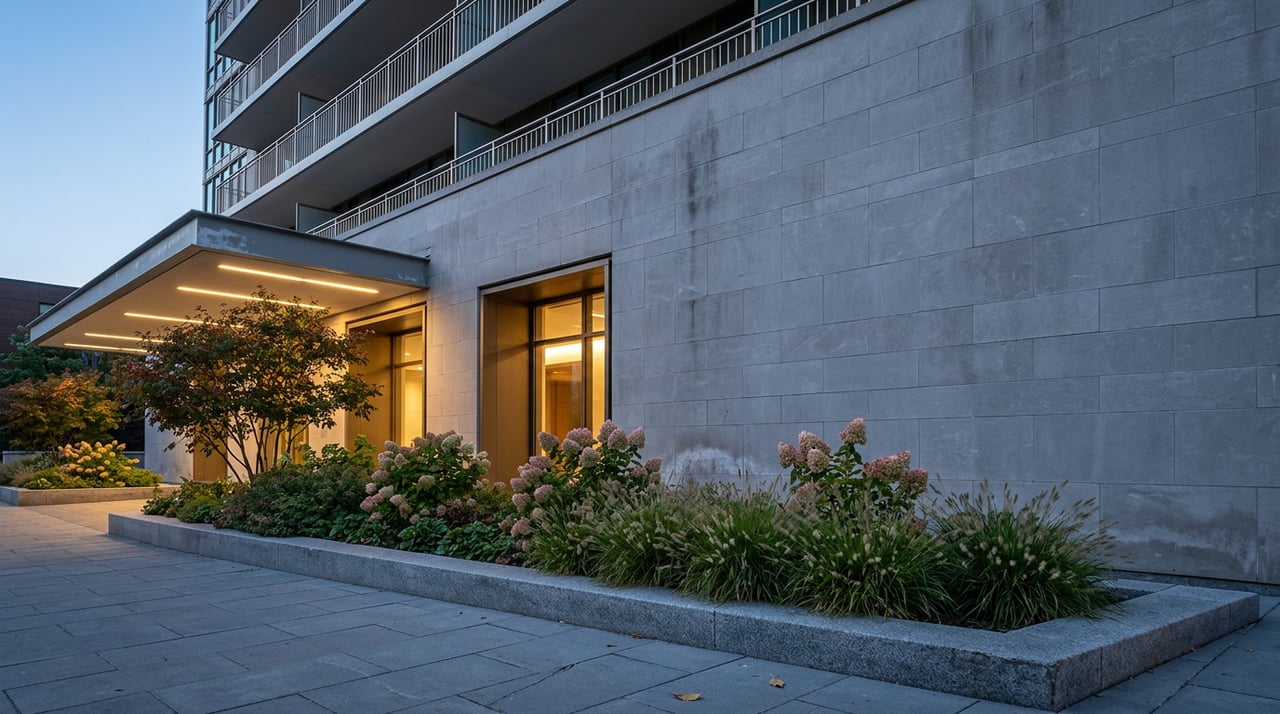
The old Leona's site at 6935 N. Sheridan tells you where the residential density conversation is going. The Chicago City Council has approved plans for a mixed-use development at 6935 North Sheridan Road at the corner of West Morse Avenue, designed by MC & Associates as a five-story building clad in a mix of white and light red brick with black metal accents, replacing a long-vacant commercial structure that previously housed Leona's Restaurant. Whether you think that trade is right for the block is a matter of taste. What is not a matter of taste is that a five-story residential building next to the Morse station changes weekend foot traffic on Glenwood, which changes what a business like the future firehouse concept can support.
The theaters keep the district honest
The reason Glenwood is not just a mural walk is the stages. The district is home to two award-winning theaters, Lifeline Theatre and Rhapsody Theatre, along with a variety of live music venues, art studios, and galleries, all close to unique and friendly bars and restaurants. Programming here does not go dark in August the way it does in some of the Loop houses. If GAAF pulls you back to Morse and Glenwood on the 14th, the theater lineup is what pulls you back on the 24th.
A weekend that only works here
Put the pieces together and you get a specific August Saturday that is not available in any other North Side neighborhood. Sunrise walk on the Loyola Beach Dunes trail. Coffee at Monarch on Clark before the Metra crowd. GAAF from noon to three, out and back on the Red Line at Morse. Late lunch on Glenwood. Lap swim in the Lunt-to-Farwell lane before the lifeguards clock out at seven. A show that night at Lifeline or Rhapsody.
None of the individual stops is a secret. The sequence is the neighborhood.
Thinking about a move within Rogers Park, or curious what your building is worth in a market that is quietly densifying around the Morse and Jarvis stations? Blume Group tracks these blocks the way residents do. Get a Free Home Valuation and we will walk you through what your address is doing right now.